subcog
by zircote·★ 22·Score 45
Persistent memory system for AI coding assistants with MCP integration, hybrid search, and knowledge graph features.
Overview
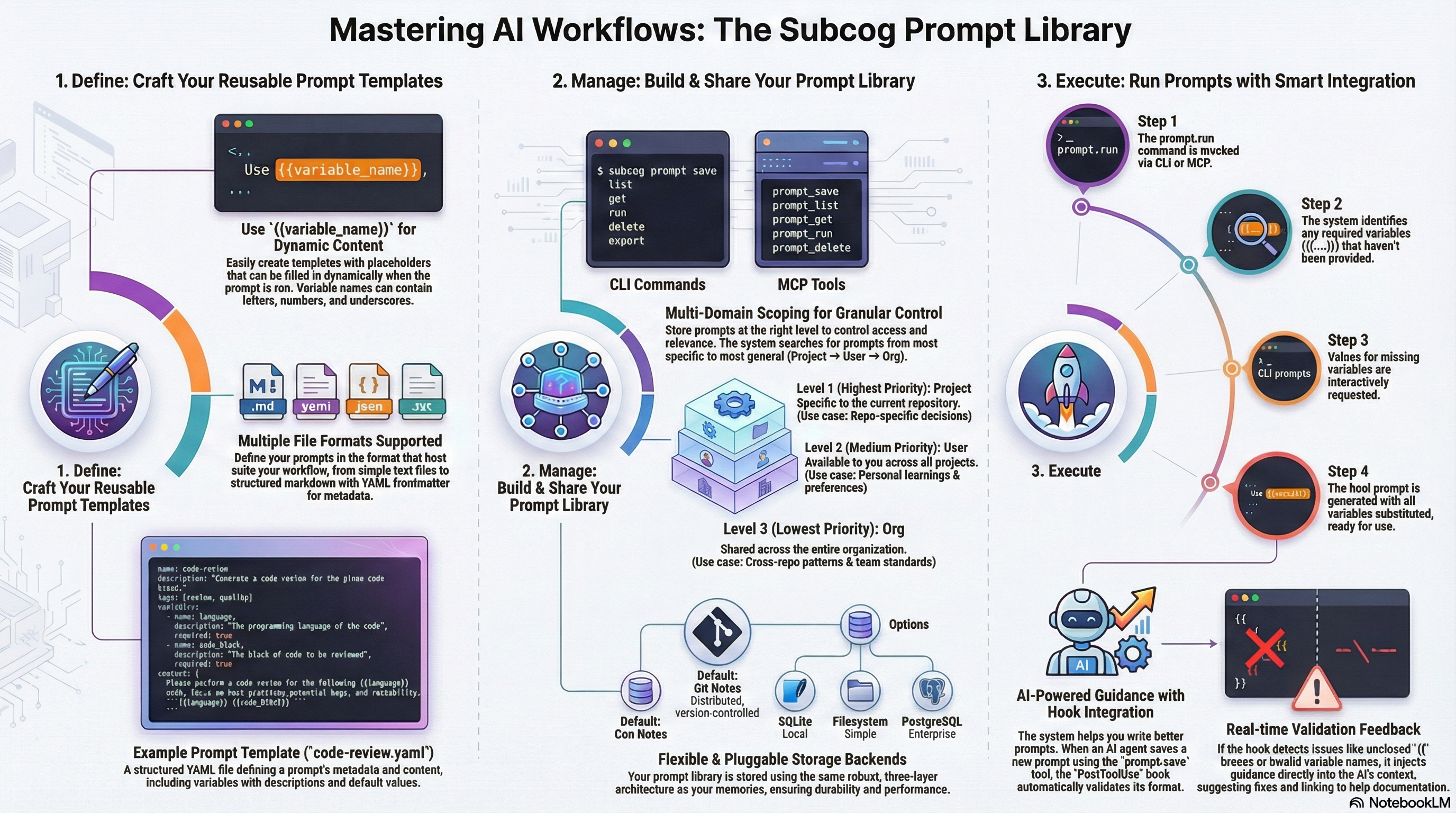
Subcog is a sophisticated memory system designed for AI coding assistants that captures decisions, learnings, and context from coding sessions. Built in Rust, it offers a three-layer storage architecture with SQLite persistence, FTS5 indexing, and usearch HNSW vectors for semantic search. The system provides MCP server integration for seamless AI agent interoperability, supporting about 22 consolidated MCP tools for memory CRUD, search, knowledge graph operations, and prompt management. It features hybrid search combining BM25 text search with vector similarity scoring, normalized for intuitive relevance understanding.
Try asking AI
After installing, here are 5 things you can ask your AI assistant:
When to choose this
Choose Subcog when you need a persistent memory system specifically for coding assistants, particularly if you're already using Rust or Claude Code and want seamless IDE integration.
When NOT to choose this
Avoid Subcog if you need a general-purpose knowledge management system, or if you require authentication/authorization beyond simple JWT tokens for the HTTP transport mode.
Tools this server exposes
12 tools extracted from the READMEsubcog_captureCapture a new memory with optional namespace and context
subcog_recallSearch memories using hybrid semantic + BM25 search
subcog_statusCheck the status of the memory system
subcog_consolidateConsolidate memories to reduce redundancy
subcog_getRetrieve a specific memory by ID
subcog_updateUpdate an existing memory
subcog_deleteDelete a specific memory
subcog_listList memories with optional filtering
subcog_graphQuery the knowledge graph for relationships
subcog_entitiesExtract entities from memories
subcog_promptsManage prompt templates
subcog_initInitialize a new session with Subcog
Comparable tools
Installation
Subcog can be installed via multiple methods:
# Cargo (recommended for Rust developers)
cargo install subcog

# Homebrew (macOS/Linux)
brew install zircote/tap/subcog

# Docker
docker run --rm ghcr.io/zircote/subcog --help

# Binary download
curl -LO https://github.com/zircote/subcog/releases/latest/download/subcog-VERSION-TARGET.tar.gz

# npm/npx (fallback)
npx @zircote/subcog --help
To use as an MCP server, add to Claude Desktop's claude_desktop_config.json:
{
  "mcpServers": {
    "subcog": {
      "command": "subcog",
      "args": ["serve"]
    }
  }
}
FAQ
- What storage backends does Subcog support?
- Subcog supports SQLite as the default backend with optional PostgreSQL support. For vector storage, it uses usearch HNSW with pgvector and Redis Vector as alternatives.
- How does Subcog protect sensitive information?
- Subcog includes built-in secrets detection for API keys and passwords, optional PII filtering, encryption at rest (enabled by default), and comprehensive audit logging for compliance requirements.
Compare subcog with
Last updated · Auto-generated from public README + GitHub signals.