hister
by asciimoo·★ 959·Score 52
Hister is a privacy-focused search engine with MCP support for AI-enhanced querying.
Overview
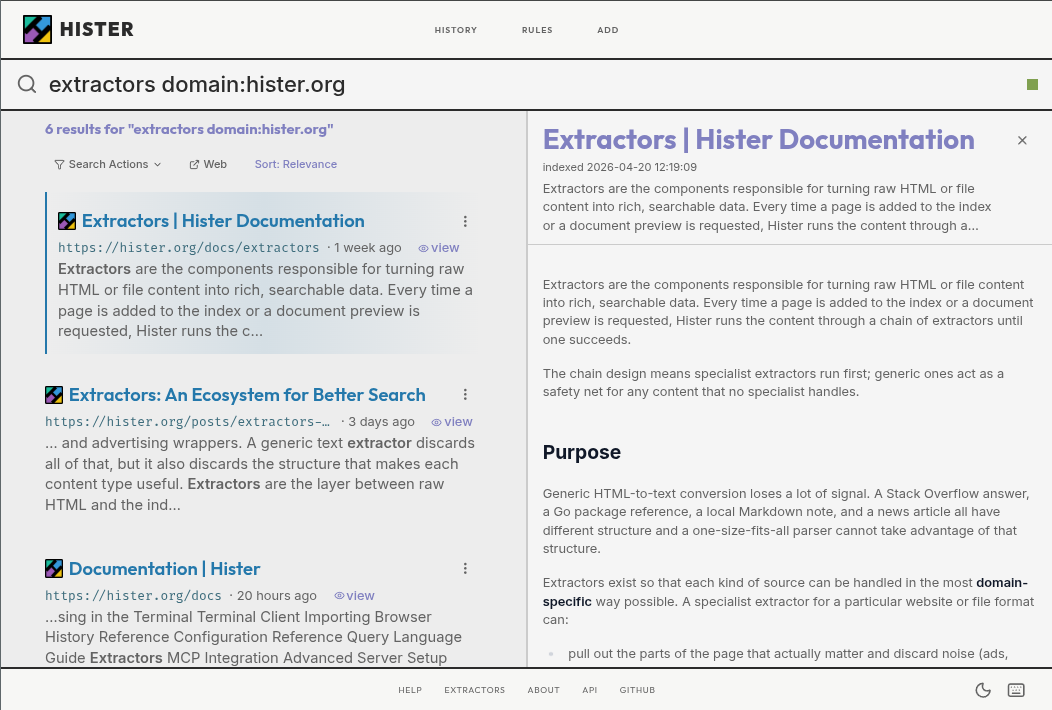
Hister is a general-purpose web search engine built in Go that provides automatic full-text indexing for visited websites. It emphasizes privacy by keeping browsing history indexed locally rather than relying on remote search engines. The project offers advanced search capabilities with a powerful query language, local file indexing, and support for both headless browser and traditional crawlers. Notably, it includes MCP integration to enable semantic search and connect AI agents directly to the search functionality.
Try asking AI
After installing, here are 5 things you can ask your AI assistant:
When to choose this
Choose Hister when you need a privacy-focused search solution that can be integrated with AI agents via MCP for enhanced search capabilities.
When NOT to choose this
Don't choose Hister if you need enterprise-level features, user authentication, or require cloud-hosted search with high scalability.
Comparable tools
Installation
Installation
- Clone the repository:
git clone https://github.com/asciimoo/hister.git - Build with
./manage.sh buildorgo generate ./...; go build - For development with hot reload:
`` npm run serve:app ``
Claude Desktop Configuration
Add the following to your Claude Desktop configuration:
{
  "mcpServers": {
    "hister": {
      "command": "path/to/hister",
      "args": []
    }
  }
}
FAQ
- How do I enable MCP functionality in Hister?
- MCP support is mentioned as an 'AI enhanced' feature in the README. You would need to configure it in your Claude Desktop settings by specifying the Hister command path.
- What search capabilities does Hister offer?
- Hister provides full-text indexing of visited websites, local file indexing, advanced query language support, and optional semantic search through AI integration.
Compare hister with
Last updated · Auto-generated from public README + GitHub signals.