MegaMemory
by 0xK3vin·★ 168·Score 50
MegaMemory is an MCP server that creates persistent project knowledge graphs with semantic search for coding agents.
Overview
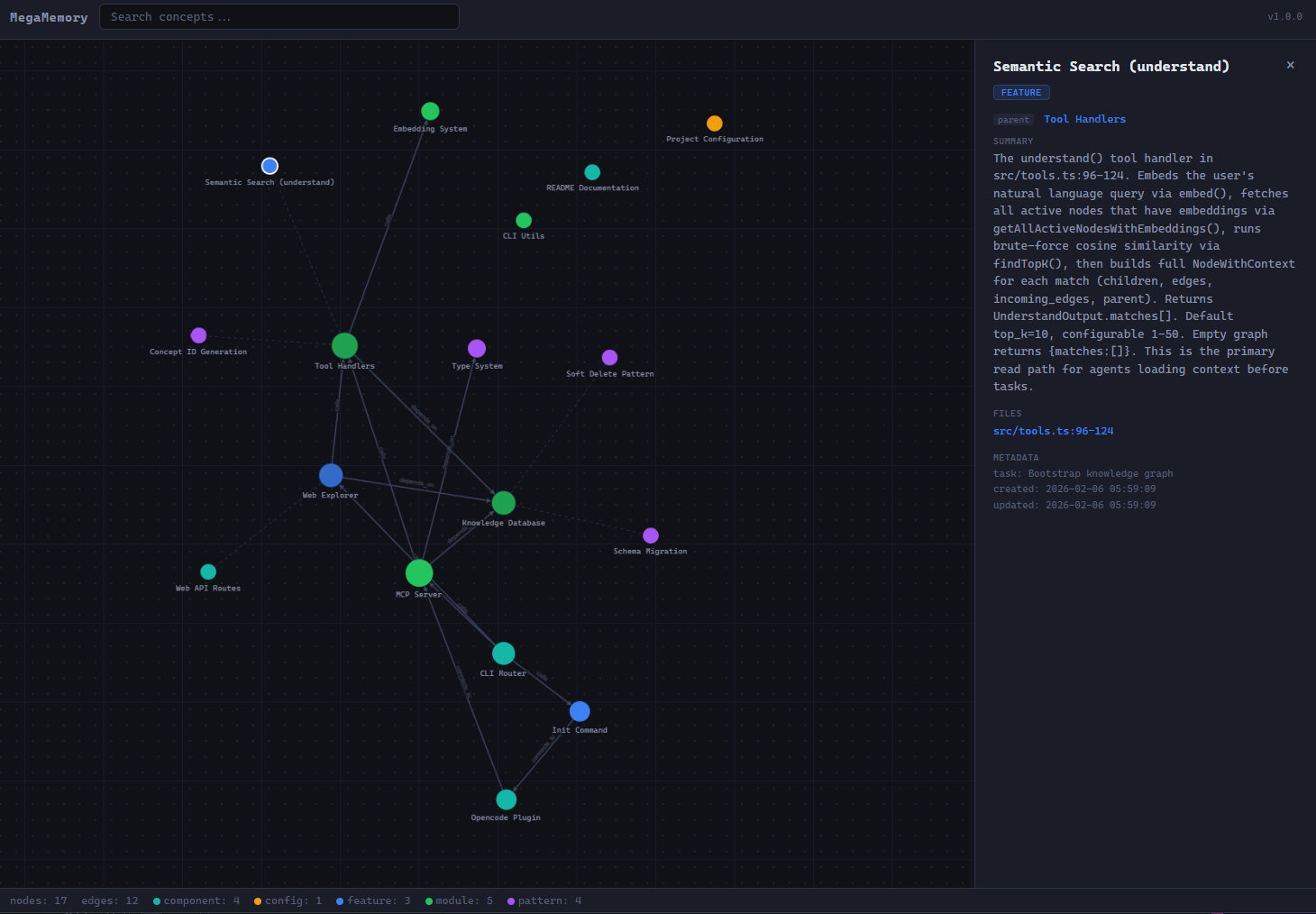
MegaMemory allows coding agents to build and query a graph of concepts, architecture, and decisions across sessions. Using LLM-generated concepts rather than AST parsing, it creates a knowledge graph that persists in SQLite. The server provides tools for understanding project context, creating/updating concepts, managing relationships, and resolving merge conflicts between different versions of the knowledge graph. It includes a web explorer for visualization and supports multiple MCP clients.
Try asking AI
After installing, here are 5 things you can ask your AI assistant:
When to choose this
Choose MegaMemory when your coding agents need persistent memory across sessions without complex AST parsing, especially for projects where architectural understanding evolves over time.
When NOT to choose this
Avoid MegaMemory if you need real-time code symbol analysis or have projects with strict zero-disk-usage requirements, as it stores all knowledge locally in SQLite.
Tools this server exposes
9 tools extracted from the READMEunderstandSemantic search over the knowledge graph. Returns matched concepts with children, edges, and parent context.
get_conceptLook up a concept by its exact ID. Returns full context including children, edges, incoming edges, and parent.
create_conceptAdd a new concept with optional edges and file references.
update_conceptUpdate fields on an existing concept. Regenerates embeddings automatically.
linkCreate a typed relationship between two concepts.
remove_conceptSoft-delete a concept with a reason. History preserved.
list_rootsList all top-level concepts with direct children.
list_conflictsList unresolved merge conflicts grouped by merge group.
resolve_conflictResolve a merge conflict by providing verified, correct content based on the current codebase.
Comparable tools
Installation
Installation
npm install -g megamemoryFor Claude Desktop
Add to Claude Desktop configuration:
{
  "mcpServers": {
    "megamemory": {
      "command": "megamemory",
      "args": []
    }
  }
}
For Other MCP Clients
megamemory install --target <client-name>Where client-name can be opencode, claudecode, antigravity, or codex.
FAQ
- How does MegaMemory store knowledge?
- It uses SQLite with WAL mode, storing concepts as nodes with relationships as edges. Each project has its own database at .megamemory/knowledge.db.
- Does it require API keys or network calls?
- No, embeddings are processed in-memory using the all-MiniLM-L6-v2 model that downloads once (23MB). No API keys needed.
Compare MegaMemory with
Last updated · Auto-generated from public README + GitHub signals.